Sunday, May 14, 2023

San Diego - The Other City of Brotherly Love

Aloha all,

my bother and his family usually lives 12,000km away, but he currently does a sabbatical at San Diego State University. That's only 4,000km from Maui, so of course we went to visit them. We would have stopped anywhere between Hawaii and North Carolina to see them, but we enjoyed that it was San Diego, which has always been on our list of places to go when the volcano blows.

The view from Coronado to Downtown San Diego

We spent just over a week in and around San Diego and, as always, we are amazed how much we have seen and done in such a short time. We love Maui, but life is so full when you are traveling.


Being loving brothers means we split our time fairly evenly between pleasant excursions and vicious competitions. We played four different disc golf courses. The results were better for me when we played on weekday mornings while Hannes had to be in school.

He might lose more discs,
but we lose more rounds

San Diego has a great variety
of disc golf courses 

We also got to play beach ultimate, which is always a fun, but humbling experience. If I am not forgetting something, this was the first time I played ultimate on the US mainland. As usual in ultimate, the local players on Mission Beach were friendly and equally welcoming to all of us. But I think they were a little more impressed by Hannes, who can actually run in the soft sand, in contrast to his dad and his uncle.

Beach Ultimate at Mission Beach
For a less strenuous, but equally fierce competition we played Settlers of Catan and Chess. We also played a few rounds of pool, but it's a bit of a blur because Sandra sank all her balls except the black 8 in one turn. It was definitely the peak of her pool playing career.

I tied my brother in chess; against Hannes
I got redemption for the close disc golf losses

We took a weekend excursion to Joshua Tree National Park. Along the way we saw the longest running outdoor play in the US. “Ramona” has been performed at the “Ramona Bowl” in Hemet, CA since 1923!  So it looks like they have their math right, we got there just in time for the centennial season. It’s a refreshingly honest depiction of early California history. Just proving that this is a great country, even while or maybe even more so when pointing out some flaws. And it's not a woke, modern production. The book was written in 1884 and the play has been a beloved event here for 100 years. 


The setting and the production is very impressive, with about 100 actors and a dozen horses on a spectacular, natural stage. In my view, the Ramona Bowl competes with Red Rocks in Colorado for the best outdoor performance venue in the country. 

The centennial season of "Ramona"

As you probably all know, we love any National Park, and Joshua Tree is no exception. We had not been there in about 30 years...about time for a return visit! The funny looking trees, the blooming cacti and spectacular wildflowers alone are worth a trip at least once a decade. We don't get desert plants like that even in the dry areas on Maui. And what a treat to be there in the spring blooming season...and before the summer heat. In San Diego, it was unusually chilly at times; on our hike at Joshua Tree NP we loved the cool breeze.

A Joshua Tree at Joshua Tree National Park

Cactus in bloom
Devil's Horns or a Joshua Halo?
There is something about a blooming cactus 

On our way back to San Diego, we were able to briefly visit Tom & Lori in La Quinta. They are friends from Maui who moved to the desert a few years ago. Always nice to see where friends live and we’ll put it on the list of places to visit a little longer whenever we make it this far west in Joy. Tom has already promised us 24 feet to park Joy in their beautiful community; now I just need to negotiate a 24 stroke handicap when we play a round on their private golf course.

A hui hou, Tom & Lori!

Back in San Diego, we explored several neighborhoods: The history of Old Town, the gardens and museums of Balboa Park, the intriguing little Map Museum of La Jolla, a short visit close to the Mexican border at the Tijuana Estuary, a fun walk in San Carlos, where Japeha live and the impressive coast at Torres Pine State Park.

Cactus Garden at Balboa Park

If they build a tower,
Chris & Sandra will climb it.

Cliffs at Torres Pine State Park

Maybe my favorite new discovery of this week were the Velella Velellas or "By-the-Wind Sailors". We saw hundreds of these unique creatures, (which surprisingly are not jellyfish, but their own genus of animal). It’s fairly rare to see them, because usually they float on the open ocean. But their only mode of transportation is to use their translucent sails to let the wind blow them across the ocean. Every few years, the wind blows the wrong way for too long and thousands of them end up on a beach. That’s bad for the Velella Velellas, but makes for great pictures:


Velella Velella on the beach

Velella Velellas on the beach

We also went to a high school theater play at the Patrick Henry High School, where Hannes goes to school. Well, technically, we went to half a play. Even though the school is named after arguably America’s greatest orator of all time, the quality of the production was not quite up to Patrick Henry’s standards. Maybe we are a little spoiled from the excellent performances we saw at Baldwin and Seabury on Maui. But if Patrick Henry had forgotten his words and had gotten lost in his notes, I doubt he would have inspired a revolution like he did.

Last year, we met a descendant of Patrick Henry,
now we know a student of Patrick Henry High School.

It’s always nice to have a local connection: Even though they just moved there a few weeks ago, Jan and Petra had already scouted out a lot of local breweries. It seems like they check out a new brewery almost every time they drive Hannes to basketball practice. And Hannes has enough basketball practices that Jan & Petra might get to know all 160 breweries in San Diego before they leave. Lucky for them, San Diego has the most and the best local breweries anywhere in America. We have learned that this is a distinction claimed by every single place in America, with the possible exception of the areas north of Fairbanks, Alaska and the Hawaiian islands northwest of Kauai. 

With that logo, the Pure Project Brewery is
a natural favorite for a hydrology professor 

And that’s the news from Lake San Diego, where all the disc golf courses are pretty, half of the theater plays are spectacular and all the breweries are better than average.


Chris & Sandra


Saturday, October 29, 2022

North Carolina - Loving it all the way to the Outer Banks

Aloha all,

“First in Flight” is the motto on most North Carolina license plates in honor of the Wright Brothers, who were the first humans to fly in Kitty Hawk, NC. 


Sounds about right, doesn’t it? 


That’s what I would have said until we got there last week. But as so often, history is a little more complicated than what fits on a license plate.

Orville, Chris & Sandra not in Kitty Hawk

First of all: Humans had been flying since 1783. That's when the first manned hot air ballon took off. Countless humans, including the Wright Brothers, had experimented “flying” somewhat successfully with gliders for years. So what the North Carolina license plates should really say is “First in powered, controlled flight with a heavier-than-air aircraft”. 


Also, Orville and Wilbur Wright did not fly in Kitty Hawk, that’s just where they had to go to send a telegram to their dad to let him know of their success. The flights actually took place at “Kill Devil Hill”. To be honest, I think that’s a much more appropriate name for such a dare devil achievement. 

Replica of the "Wright Flyer"
with a few original parts and
Kill Devil Hill in the background 

The very first flight took place on December 17th, 1903. Orville Wright flew 120 feet, which took 12 seconds. That’s less than 7mph, which means he could legally fly around the campground where we are currently staying, where the speed limit is 8mph. But the learning curve of human flights was very steep: On the second try, Wilbur made it to 175 feet. Not to be outdone, on the third flight Orville flew for 200 feet. The fourth and last flight of the day was by Wilbur and was 852 feet long! It lasted 59 seconds, even breaking the campground speed limit. And a mere 66 years later, humans flew 1,261,392,000 feet to the moon!


Captivating Ranger Talk
at the lift-off point

Other than missing the brains and the guts to do anything like this, I can totally relate to the Wright Brothers. I love the story how they flipped a coin to decide who gets to go first and then alternated with each attempt. I can also imagine the two brothers arguing for years who was really the first: Orville claiming to be the first making it airborne while Wilbur reminding his little brother that he flew more than four times as far that day. I know my brother and I could argue about that for years. Well, at least I made it to the site of the first flight before my brother did. I wouldn’t be surprised if the next time my brother is in Paris, he will find the spot where the first hot air ballon took off. And then he will remind me that this was 120 years before the Wright Brothers ever flew.

In 1587 English settlers started a colony on Roanoke Island on the Outer Banks of North Carolina. That’s 33 years before the Pilgrims settled in Plymouth and 20 years before our friends arrived in Jamestown. But don’t worry, this is not going to be another essay about who really founded this country. Nobody claims Roanoke as the origin of America. The only thing Roanoke is known for, is being the “Lost Colony”. Very little remains of the actual settlement. However, the guided tour and the exhibits and the film at the visitor center tell a fascinating, but tragic story:

No human remains and very little physical evidence
of the "Lost Colony of Roanoke" was found.

The colony was struggling from the beginning. One of the few bright spots in the story is that on Aug 18th, 1587, the first baby of European descent was born in America. Why Captain John White, the leader of the colony, had taken his pregnant daughter on this journey is beyond me. He did not get to be with his granddaughter very long. Only one week later, when the ships that brought the settlers to the new world left, the colonists asked John White to return to England to secure more supplies. Well, the oceans in the 16th century were anything but secure. Storms, pirates and wars kept a increasingly desperate White from returning to Roanoke for the next three years. By the time he returned, all the settlers, including his daughter and granddaughter, had vanished. Unfortunately, the captain of the ship White came with refused to investigate any further. 

To this day, no evidence has been found, not even any good clues, what might have happened to them. They might have died from disease or starvation, there might have been a natural disaster or Indian attack. The most optimistic theory is that some of them might have been adopted by native tribes since later explorers reported some fair skinned and even red haired natives. 

This stone marks the birthplace of Virginia Dare,
the first baby of European descent born in America

Roanoke is also home to another bitter sweet history: During the Civil War, it became the  first “Freedmen’s Colony”. Starting with the Union’s takeover of Roanoke Island in 1862, it became a safe haven for fleeing slaves from the South. Many of them joined the Union troops as soon as that was allowed. Ironically, the Union’s victory they helped to achieve was also the reason the Freedmen’s Colony was dissolved. After the war all confiscated land was given back to the original owners, including this part of Roanoke, where thousands of African Americans had established their first homes as free people. 


Up to this point, what we had seen of the Outer Banks had been pretty developed and pretty close to the mainland. That started to change on Pea Island. From here on out, we saw more birds than humans and most of the humans we did see were fishing. The islands get increasingly narrow, sometimes we could see the water on both sides of the road. What we couldn’t see anymore was the mainland. The Outer Banks are up to 30 miles 'out there'. Looking at it on a map, it seems crazy to drive, let alone live on such a narrow strip of land way out in the ocean. I know, Hawaii is also just a tiny speck of land and even more isolated, but at least it’s not just made of shifting sand. 

After seeing some of the beaches here,
I feel we need to rename Big Beach on Maui


We spent two days at the Cape Point Campground on Hatteras Island and were fascinated by the history of the Hatteras Lighthouse: It’s not mentioned in the musical, but according to the national park ranger, Alexander Hamilton was instrumental in getting Congress to fund a lighthouse there in 1794…after he almost shipwrecked there himself. The original lighthouse was replaced by the current tower in 1870. At almost 200 feet in height it was and still is the tallest brick lighthouse in America. Well aware of erosion, they built it over 1500 feet inland from the beach. But only 50 years later, the beach was only 300 feet away. Groins were built, which slowed the speed of erosion. But in 1997, the National Park Service made the controversial decision that the lighthouse had to be moved to be saved. 

Hatteras Lighthouse:
The tallest (and fastest) brick lighthouse 

We have been to many historical homes that have been moved. Seems to be easier than I thought. But most brick buildings were moved brick by brick and therefore are rather ‘rebuilt’ than actually ‘moved’. Not the Hatteras Lighthouse! In 1999, they moved the whole thing by over half a mile, all 147,000+ bricks and all at once! We listened to the ranger talk about the move and watched a documentary on YouTube, aptly called “The Move of the Century”. It musty have been quite the spectacle with tens of thousands of people coming to the Outer Banks to see the lighthouse move. To show his confidence that this could be done safely, the park superintendent rode on top of the lighthouse the first day. Everything went well and they even seem to have had some fun with it: They put up signs cautioning drivers of “Crossing Lighthouses”. They even put up a stop sign for the lighthouse inches before the final destination. When the lighthouse moved past the stop sign by a few inches per minute, they issued a ticket for running the stop sign and for “exceeding the safe speed for a lighthouse”. Do you know what the Hatteras Lighthouse and my mom have in common? A few inches per minute is also the speed that my mom claimed to drive when she once got a ticket for not stopping at a stop sign. And I believe her, because my mom is the most careful driver and the most honest person in the world. 


Beware of crossing lighthouses!


I had no idea you could move a lighthouse that size, but that was not the only thing we learned in the museum next to the Hatteras Lighthouse and later at the “Graveyard of the Atlantic” Museum. We also had no idea that German U-Boats attacked American ships just off the coast in North Carolina during both world wars! I didn’t even think that over 100 years ago submarines existed that could cross the Atlantic. During World War II, the U-Boats did serious damage. Apparently the government kept the attacks so close to American shores secret in order to avoid panic. The secrecy worked very well, it took over 80 years for us to find out!


Random picture of the shells
at Cape Point Beach


Not so random picture of shells
at Cape Point Beach

We went for a beach walk to Cape Point on Hatteras Island, where the Gulf Stream and the Labrador Current meet. I have never seen so many pretty sea shells on one beach in my life. Apparently the fishing is really good at the point, too. Despite miles and miles of wide and basically empty beaches on either side, the tip of the island is as crowded as Waikiki. Just more trucks and less bikinis, at least this time of the year. We might have been the only people not fishing on Hatteras Island, but we were not the only ones not catching any fish. Our new friends from Ohio did not catch anything either. But they did not seem to mind, because they still had enough beer to share with strangers on the beach and enjoy one of the most memorable sunsets we have ever seen:


Who cares about catching fish anyway?


Amazing sunset even by Maui standards


From Hatteras Island to Ocracoke Island, Joy got to take another ferry ride, this one was even free! Ocracoke is a cute town, but by that time the weather wasn’t that cute anymore, so the next day, we took another ferry back to the mainland. 


We spent a day at the very impressive Fort Macon. It was planned after the War of 1812 to protect America from the British. As we now know, the British never attacked the US again. But America attacked America. The only time Fort Macon saw any action was during the Civil War. The Confederacy took it without a fight in 1861, only to give it up in 1862 after a siege and one day of bombardment by the Union.  


Fort Macon by Morehead City


The fort was used again briefly during the Spanish American War. After that, it was neglected. In the 1930’s the good old CCC boys helped restore it to become North Carolina’s first functioning State Park. Army troops were stationed at Fort Macon once more during World War II, because of them German U-Boats off the coast, but it was never actually needed. To top off our day, we met for dinner with another Maui expat friend who moved back to Morehead City, NC.


Dinner with Terry & Jen

Of course we had to go to New Bern, if only for the name. New Bern was the first capital of the North Carolina colony. Apparently, they saw how successful Williamsburg was in reviving their colonial capital, so they decided to do the same thing, albeit on a much smaller scale. But we enjoyed the tour of the reconstructed “Tryon Palace”, which was the governor’s family’s mansion and the seat of the colonial government. 


"Tryon Palace" in New Bern, NC


Tour of the colonial capitol

The royal governors did not last very long in Tryon Palace. The last royal governor fled during the early rumblings of the revolution in 1775, over a year before the Declaration of Independence. That’s why in New Bern, they claim to be the first ones to actually achieve independence. We also enjoyed the beautiful gardens around the palace and the North Carolina History Center.

One of the Gardens at Tryon Palace

The other claim to fame of New Bern is that it’s the birthplace of Pepsi. We walked past the soda shop where Pepsi was first mixed in 1898. That’s 12 years after the first coke was served in Atlanta, but I still find it amazing how long these sugary waters have been around. I wonder whether the Wright Brothers preferred Pepsi or Coke.

The very first Pepsi was served here


But even with all that, New Bern does not offer quite as much as Williamsburg, so we were able to see everything we wanted to see and still had time for one last ocean front dinner …until we are back on Maui. 


The Last Sunset Supper


Now we have found a place to store Joy and will fly from Raleigh with a quick detour via Chicago back to Maui. We’ll be home by November 6th. Our last fun site of this road trip was the Vollis Simpson Whirligig Park in Wilson, NC. We didn't know who Vollis Simpson was or what a whirligig is, but you can't help but smile when you see them whirling in the wind.


Whirligig Park in Wilson, NC

Even Joy enjoys Whirligigs

Now we are preparing Joy for her winter hibernation. To prepare ourselves for our return home, we practiced our golf and pickle ball skills.

Lane Tree Golf Course in Goldsboro,
at only $14 for 9 holes with a cart
it's the best deal outside of Waiehu

I want to congratulate you for making it to the end of the last blog post of this year's road trip. We truly are looking forward to coming home to Maui. But if we were to get itchy feet again next spring, you can read all about it right here.


A hui hou, Joy!

Chris & Sandra


Thursday, October 20, 2022

Hobby Historians at their Happy Place

Aloha all,

Joy’s blog post last week was so popular that I am afraid some of you might be disappointed that she doesn’t get to write this one. It’d be a lot shorter, since she spent most of the week on the parking lots in and around Williamsburg. Don’t tell her, but I think she missed some of the most interesting sites of this trip.


There is natural beauty and fascinating history all over this country, but it’s not evenly distributed. The Southwest has more than its fair share of natural wonders, but you still have to drive a few hours to get from the Grand Canyon to Bryce Canyon or Zion. Virginia has three of the most important places in American history less than 20 minutes from each other: 


Jamestown probably has the best claim for being the origin of this country. If you thought it was Plymouth, you might want to read on. 

Williamsburg might be the closest thing to a time machine we will ever have. If you don’t know what I mean by that, you might want to read on.

Yorktown might be the site of the most important battle for American Independence. If you know as little about Yorktown as we did until last week, you might want to read on.


Bush Gardens is right in the middle of it, too. But who has time for a regular theme park when you can have these kind of authentic historical theme parks? We spent a full week in this historical triangle and still have not seen everything. But here is what we did see:

Replicas of the boats that brought
the first settlers to Jamestown in 1607

At Jamestown we spent one full day at the actual historical site, where English settlers arrived in 1607. Then we spent a second full day at the place next door where they reconstructed the three ships that brought the first settlers, the fort and a Powhatan Indian settlement. We had been there in 2005, but this is how bad our memory is (or how prevalent some common misconceptions are): We remembered that the Jamestown settlement was a failure; that they were starving and there were even rumors of cannibalism. We remembered that they abandoned the settlement after just a few years. It’s a good thing we went back to learn what really happened…


According to the most recent scientific consensus, the cannibal thing actually did happened. Just in the past few years, they found pretty clear evidence. But the rest of our memories were wrong. After the “Starving Times” the few surviving settlers actually tried to leave: They had already boarded their ship and sailed out of the Chesapeake Bay when a new leader, new settlers and new supplies arrived. They turned around and the settlement was actually doing quite well from there on out. For the next 92 years Jamestown was the capitol of Virginia, the most successful British colony in America at the time. 
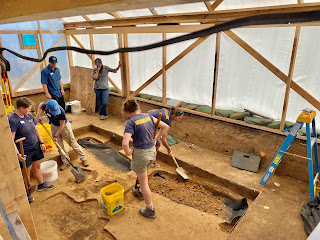

Digging up history at Jamestown 

Surprisingly, the National Park ranger guided tour in Jamestown was the less informative one. We were more confused than before. But we also got to go on an excellent tour with an archaeologist who is currently working on several of the dig sites at Jamestown. This was one of the most active archaeological site I have ever seen, they were digging all over the place. The location of the fort was actually thought lost, possibly washed away by erosion, until archaeologists rediscovered remains in 1994! They have been learning new things about Jamestown every year since. Just this year, they discovered a new thing about their own logo: What was thought to be a flag drawn on this little map by John Smith over 300 years ago, is actually a real part of the fort. They made this discovery earlier in 2022 and they are still trying to figure out what it actually was.

So over 400 years later, it turns out
that thing on the top is not a flag...

I already voiced some questions in my blog post from New England in September why Plymouth gets the reputation of being the origin of the United Sates of America. After visiting Jamestown, that claim seems totally ridiculous. 


Here are just some of the colorful events that happened in Jamestown before the first Pilgrim ever arrived in Plymouth:

1610 only 60 of several hundred settlers survived the “Starving Times”

1612 John Rolfe starts cultivating a West Indies strain of tobacco for export

1613 Pocahontas is captured, but marries John Rolfe in 1614

1616 Pocahontas travels to Europe and dies there in 1617

1619 The first representative assembly in North America is elected

1619 The first African slaves arrive

1620 The Virginia Company sends 90 young women. The settlers can marry them if they pay 150 pounds of tobacco…


So Plymouth clearly wasn’t the first English settlement in America. There were actually several earlier settlements. By the time the Pilgrims set foot on Plymouth Rock, the settlers in Virginia were already growing tobacco, capturing natives, enslaving Africans and electing their first representative assembly. 


By the way, that assembly has been in continuous existence and is today’s General Assembly of the State of Virginia. So Plymouth might be able to claim the first Thanksgiving, but Jamestown can claim the first step towards creating a representative government. So I’ll give that point to Virginia, unless you think eating turkey is more important than democracy. 


Jamestown was well established years
before the Pilgrims arrived in Plymouth

Apparently, we are not the only ones with misconceptions about Plymouth and Jamestown. We talked to several of the historians here and they had a few possible explanations: 

1. History is usually written by the winners. The north won the civil war, so maybe they were trying to claim more of the origin of the country than they deserve? 

2. Most publishers are located in New York and Boston, Virginia does not even crack the top 20. So who printed all those history books claiming that the Pilgrims in Plymouth founded America? 

3. It just sounds like a good story that the Pilgrims moved to America in search of “religious freedom”. Unfortunately, they only meant the freedom to practice their own religion, but still sounds more noble than the the main goal of the Virginia Company: They founded Jamestown to make money.


In 1699 the Virginia capitol was moved from Jamestown to Williamsburg and in 1780 from Williamsburg to Richmond. Both of those dates are important for the creation of our “time machine”. As the capitol of the largest and most prosperous colony and with the prestigious College of William & Mary next door, Williamsburg was the place to be. That’s why George Washington, Thomas Jefferson, Patrick Henry and many other Founding Fathers got their start in politics right here. Had the capitol stayed in Williamsburg, the town would probably be the size of Richmond now. Most of the colonial buildings would be long replaced and there is no way any non-profit organization could afford to turn the downtown area into a historical park. But after the capitol moved, Williamsburg became a very sleepy town. That is until 1926, when the rebirth of Colonial Williamsburg began. By now, so many of the original buildings are restored or rebuilt that it is the best place to be if you ever want to pretend you were there when the revolution was just beginning.


We had very lucky timing: Just as we arrived at Williamsburg George Washington addressed the townspeople and talked about the importance of a strong union and his hopes of winning the war. We also met Washington’s lovely wife Martha and heard how she described slavery as a ‘burden’. That sounded like a lame excuse at first. If it’s such a burden, why wouldn’t you just free your slaves? Apparently, that wasn’t always that easy. There were times when it was illegal to free your slaves. And if you had done it anyway, they could be snatched up and be sold again. Darn, history always gets more complicated the more you learn.


Martha and George Washington

We actually met Robert Carter III, the largest slave holder in Virginia. He talked about his decision to free all of his 450+ slaves and even though he was fully committed and could easily afford it, freeing his own slaves was not an easy process and ended up taking several decades.


The Marquis de Lafayette


We also had the honor of meeting the French Marquis de Lafayette. He told us how intrigued he was by the ideas of the American Revolution and that he came to America at his own expense, actually disobeying the orders of his king to stay in France. At first he was turned down when he wanted to be a general. But luckily he was independently wealthy and when he offered to serve without pay, the Americans gladly accepted. That turned out to be quite the blessing, especially later when France got into war with England and started to support the Americans officially. Even Washington confirmed, there was no way America would have won without the French Navy. However, Lafayette did say that if he had known that America would not abolish slavery during the revolution, he would not have come. Apparently, he thought when Jefferson wrote that ‘all men are created equal’, he actually meant ‘all men’. Something must have gotten lost in translation.


We also witnessed Lord Dunmore, the last Royal Governor of Virginia, just as he was deciding to free the slaves of the rebels to turn them into British soldiers to fight against their owners in return for their freedom.  


George Mason,
the Forgotten Founding Father

George Mason is one of the least known Founding Fathers, probably because he never wanted to be president and nobody wrote a musical about him. But it was fascinating to talk to him about writing the Virginia Declaration of Rights and later  lobbying for a Bill of Rights for the US constitution. 


George Washington came back on another day and by the magic of the time machine, it was 1796 when he was just finishing his second term. When I asked him about term limits, to my surprise he was strongly opposed to them. He made a valid point: If we wanted to have term limits, we would have written them into the constitution. George Washington reminded me that he spent 50+ years in public service. Personally, I still like term limits, but I will never again argue for them by saying that the Founding Fathers never intended for career politicians.


Between meeting all these famous people, we also toured the Governor’s Mansion, Payton Randolph’s fancy home and the Capitol, where we learned how Virginia was governed. We attended and even participated in a trial at the courthouse: Despite my pale skin, they mistook me for a slave. Luckily, I was able to prove that I had fulfilled my years of servitude and regained my freedom. How is that for white privilege?


Whether it's 1776 or 2022, the brickyard
 in Williamsburg is making bricks


We met a native American who talked about the traditional concept of “captive taking” in their culture. It sounds unusual by our standards, but slightly more civilized than kidnapping or slavery. We visited the brickyard to learn how to make bricks. There is an actual working cabinet maker. We went to the milliner shop, where they don’t just sell hats, but all kinds of accessories. For example, we learned what bum pads are…and I would argue that those made more sense than today’s butt implants.  


Bum pads are just what they sound like


Our fortunate timing continued: On the second day we arrived just as news of the Declaration of Independence was read on the streets of Williamsburg. We sat close to one of the local taverns keepers. He didn’t dare say it, but I got a feeling that he was actually a loyalist. He was not thrilled about the declaration, but played along with the rebels; for fear he might be driven out of business or even out of town if he spoke his mind. I guess that whole ‘freedom of speech’ thing was just a lofty goal, but not actually practiced during the revolution.


The townspeople of Williamsburg
react to the news of the day


I know it sounds unbelievable that we were so lucky, but when we arrived on the third day, the news from the first battles at Concord and Lexington broke. I guess news traveled slowly back then since the battles had already happened when we were in Concord a month ago. After the general excitement on the street calmed down, we started talking to one of the town physicians and his sister in law. He was enthusiastically calling for an open revolt, while she was more cautious and trusted that the Royal Governor would come around and address their grievances. The four of us talked for over an hour and it was a fascinating conversation. We played along and did not tell them that we were actually time travelers and knew how the revolution would end. They probably would not have believed two weirdly dressed people from some imaginary island in the Pacific anyway.


Our best friends from the 1770's


We remember listening to Patrick Henry for hours with growing enthusiasm last time we were in Williamsburg in 2008. So after visiting his Red Hill estate and meeting his great great great great great great grandson earlier on this year’s trip, of course we were thrilled to see this famous orator again. Or favorite part was when he was asked about his “ex friend” Thomas Jefferson. He went on a 15 minute rant in front of the whole town about how much of a selfish coward Jefferson was. Patrick Henry concluded by saying that even though Jefferson said all those nasty things about him, he would never sink as low as Jefferson. That’s why he would never say a bad word about Jefferson in public.


Patrick Henry is still at it


That was a befitting end to our return visit to Williamsburg. We stepped out of the time machine somewhat reluctantly, but we are already planning our return trip for next year, whatever year that might be in Williamsburg.


Great ranger program at the Yorktown Battlefield 


Yorktown is the site of the crucial victory in the Revolutionary War. Washington’s Continental Army with the assistance of the French Navy, including our friend Lafayette, beat the British decisively. According to Wikipedia, the 1781 “Siege of Yorktown” is also called the “German Battle”, because mercenaries from places like Hessen, Bayreuth and Ansbach were fighting in all three armies involved: Germans actually made up about a third of the British troops. The French column taking out the important Redoubt No.9 was under the command of some Wilhelm from Zweibrücken. And I always thought it was Washington who transformed the ragtag bunch of militias into a professional army. But George Washington and most historians seem to give most of the credit for that to Friedrich von Steuben from Prussia.


Colonial Army camp at the
American Revolution Museum at Yorktown


After the siege and a brief battle, the British surrendered and over 7000 soldiers were captured. Britain still held New York at the time, but this loss was too devastating and the king and parliament lost interest in fighting the rebellion. There were no mayor battles after the surrender in Yorktown on Oct 19, 1781. Peace negotiations began and in 1783 the Treaty of Paris ended the war, acknowledged the United States of America as an independent country and established new borders in North America, some of which are still in place today.


Washington slept here

The Revolutionary War lasted 8 years and involved battles even outside of North America, but Yorktown is probably the best place to find out how Independence was finally won. It’s also another great place to learn how terrible our memory is. We went on a long tour with a ranger and half way through the museum before a tent from General Washington looked a little bit too familiar. Then I finally realized that we had been here before. I really should read my own blog more often. This time, we also spent a full day in the adjacent American Revolution Museum. Maybe that helps us remembering at least some of the things we learned. If not, we’ll just have to come back.


Colonial and Revolutionary Greetings from Virginia,

Chris & Sandra