Friday, September 21, 2018

Bringing Joy to Canada - 10th update from Chrisandra's Roadtrip

Aloha all,
we’ve been road tripping as a threesome with Sandra’s sister for the past weeks. We slowed our tempo a little bit to give Petra some much needed and well deserved rest. We also mostly honored her request not to go to any museums while she’s with us. I guess she got scared when she read how much time Sandra and I can spend in a museum. You might want to thank Petra; imagine how long this blog would be if I also told you about the 17 museum we did not go to. 

But we’ve still seen a lot: We time traveled to a British fort in 1775, we spent two care-less and car-less days on Mackinac Island, hiked across dunes, learnt what a “tridge” is, had the best Italian food since Pompei, went to arguably the most German town in America, brought Joy to Canada, drove a boat into a waterfall, heard the Canadian perspective of the war of 1812 and spent two days walking, biking and eating our way through Toronto.

Mackinac Island and Michilimackinac were two of our favorite places on our 2008 road trip, so we did not mind going back there to show them to Petra, specially since both places turned out to be new and improved. The fort at Michilimackinac is recreated as it was in 1775, when this was still a British Colony. To bring the history of the fort alive they don’t just dress up in colonial clothes, they showed us how they are made, they don’t just talk about the importance of the tea trade back then, they also served us tea. They don’t just tell us how bread was baked back then, they also baked some fresh bread for us. All the programs were really well done, even better than in 2008.

Colonial Fort Michilimackinac with the 'Big Mac' Bridge behind it
Mackinac Island itself did not get any better in the last 10 years. In fact, time seems to be standing still there. Everything looked exactly like when we were there last. But we were able to improve our experience this time around: Instead of just doing a day trip, we spent a night on Mackinac Island. They banned cars on Mackinac Island in 1898, shortly after automobiles were invented, to protect the horse carriage businesses. I don’t think they realized how smart that was. All the pretty houses and gardens would not be the same if there were noisy cars and trucks instead of bikes and carriages.

Our Bed & Breakfast on Mackinac Island
Most hotel and vacation rental rates on Mackinac make Maui look cheap, but we were lucky and found the cutest bed and breakfast or technically a “bed, breakfast and tea”, which is in one of the oldest or maybe the oldest victorian home on the island. Spending a night there gave us plenty of time to explore the town, the fort and even the very exclusive hotel. We also biked around the whole island, took a horse carriage tour and made new friends at the Pink Pony, one of the bars where locals and tourists seem to be equally happy.

Tandem Ride around Mackinac Island
Both forts on Mackinac and at Michilimackinac switched hands several times over the years between the British, French and American forces. I will not bore you with all the details (even though of course I remember everything!), but I found these two stories particularly interesting: In 1763 Indian tribes attacked the fort at Michilimackinac by staging a ball game outside of the fort, pretending that a ball was mistakenly hit towards the fort’s entrance and then use weapon, which the Indian women were hiding under blankets, to capture or kill all British soldiers in the fort. The most intriguing story of Fort Mackinac was the British takeover of the fort at the very beginning of the war of 1812. This was a month after America had declared war on Britain. However, the American soldiers station at the fort did not know this yet. Therefore they were completely surprised and totally outnumbered and surrendered the fort without a fight. Hard to believe in the age of Twitter that 200 years ago, even the soldiers themselves were not aware of a war that was declared a month earlier. This was no exception, I’ve learnt that the last battle of the same war and also one of the biggest victories for the US was won in New Orleans, three weeks after the war was officially over, but neither side had heard of the peace agreement. This might have been one of those rare situations, when a little tweet from the president would have been a good thing.

Next, we went to the Sleeping Bear Dunes National Lakeshore. Our favorite activity there was a long hike through the dunes to Lake Michigan. When we climbed up the sand dunes, I told my Apple Watch that it was a stair master exercise. I don’t think my watch has ever been so proud of me. 

View from the Sleeping Bear Dunes to Lake Michigan
But the highlight was when we saw these two medieval looking sword fighters on top of one of the dunes. It looked like the Highlander had made it to America. When we talked to them, we found out that it was actually a US Marine and his French girl friend practicing ancient German sword fighting techniques. And lucky for us, they were very eager to share their knowledge. They even knew German words we had never heard. This would have been an interesting lesson anyway, but the surreal background and turquoise colors of the lake made it an extra special experience for us.
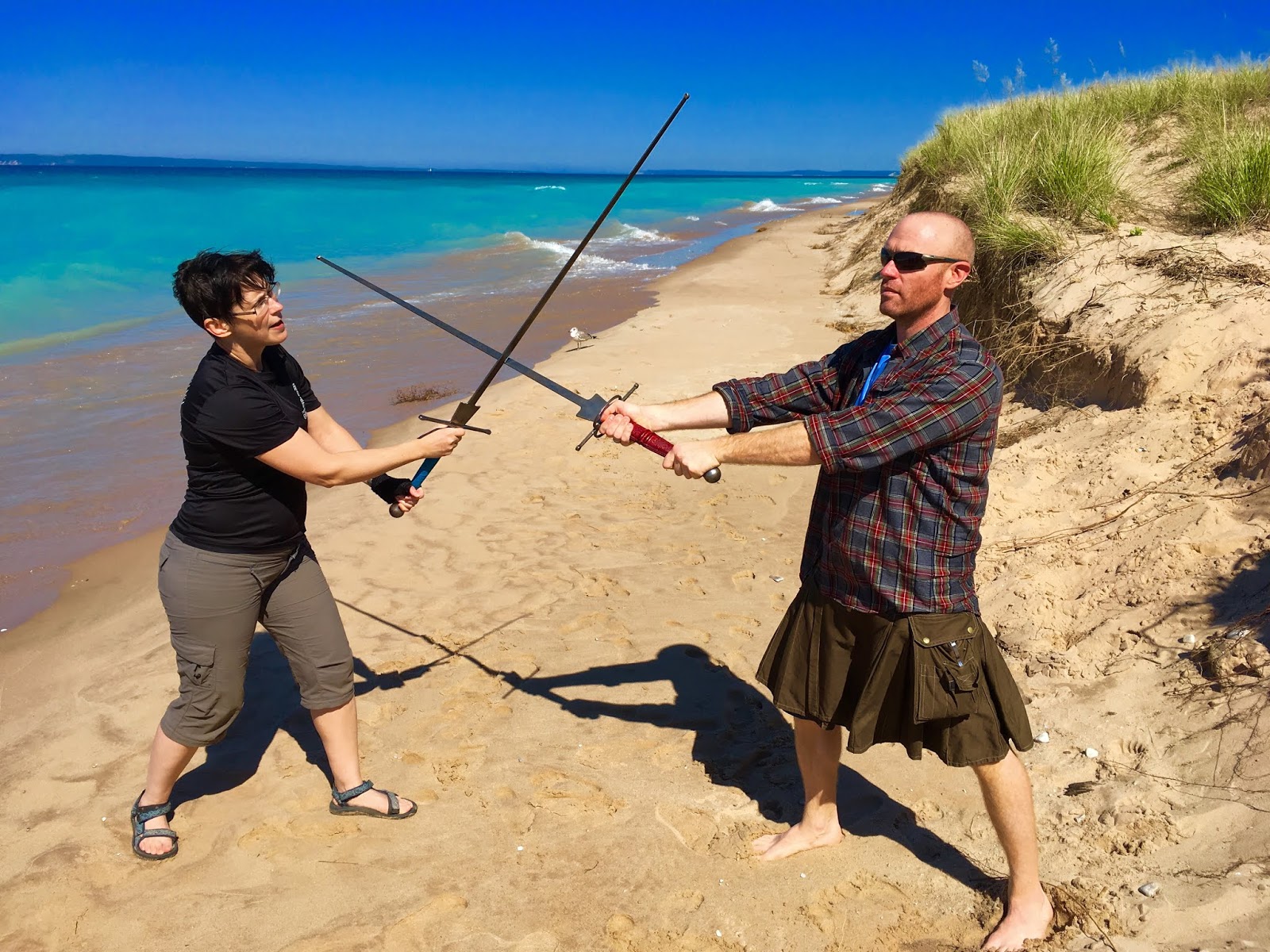
Our lesson in ancient German sword fighting at Lake Michigan
Midland in Michigan held three highlights for us: The beautiful Dow Gardens, the best Tortellini I ever had and the only tridge we have ever seen. In case you have never heard of a tridge, it’s a three-way-bridge that connects three places separated by rivers. It's a very efficient way to connect the three areas with just one structure. But to be honest, I think most people on the tridge were like us. We did not need to go to any of three places, but it’s just so beautiful that you can not help but going to all three ends to enjoy the views of the tridge.

"The Tridge" in Midland, Michigan
The next day was very German. We started off shopping at Aldi and then went to Frankenmuth, which is the most German town I know in America, even though it’s only slightly more authentic than the German pavilion at EPCOT where I worked at Disney. We went on a nice little boat tour on the “Bavarian Belle", bought some German-ish cheese and meat and had good old French crepes and some good new American micro brews. 
Frankenmuth in Michibavaria
One of the things we miss about Maui are all the plays at the Iao and ProArts Theater. But luckily, we found out that there is more to Flint than bad water. The cute little community theater put on the musical “Gypsy” and it was spectacular. Maui is extremely lucky to have so many talented actors, but it’s not the only place. The cast of “Gypsy” was extremely talented, we loved the music and the story and everybody was just as nice as at the Iao Theater. And I am not just saying this because they let us stay overnight in their parking lot after the show.

Off to Canada! The customs went a lot smoother than on our last Canadian road trip. But if we had never been to Canada before, after the first few hours, we would have thought that it’s a dirtier, stinky version of the US. The waterfalls in Hamilton had more litter than water and the otherwise nice Lakefront Park had stinky algae, trash and dead animals in the water. Luckily we were able to confirm soon thereafter that this is not typical for Canada.

The whole next day we looked at the Niagara Falls from every possible angle: From the top, from the side, from behind the falls and from a boat in the middle of the horseshoe falls. 

The Canadian version of the Maid of the Mist cruise into the falls
We also did the White Water Walk along some category 6 rapids and went to a 4D movie with some fake waterfalls. At most of these places get you so close to the water that you get pretty wet, but then they give you a poncho to keep you somewhat dry. Frugal as we are, we kept most of them and now have a collection of ponchos in just as many colors as the illuminated falls at night.

One of the many views and one of the many ponchos at Niagara Falls
On the way back from the falls, we came through Hamilton again and this time, the city made up for the not so pretty side it showed us the first time. Dundurn Castle was meant as a relatively quick stop for a guided tour, but ended up offering so much more. The architecture of the “castle” is very eclectic, the history is very interesting and the tour was very delicious. They were cooking in the old kitchen in the basement and the broccoli was yummy and we got to sample more of their produce when we toured the historically re-planted garden. The house belonged to Mr. MacNab, he had made a name for himself in the military, made a fortune for himself with some land speculation and even became premier of the Canadian colonies. The servant’s quarters in the house were surprisingly comfortable for the time and the main house not only had running water, but also porcelain toilet bows with elaborate  patterns that cost $500 each, which was about half a year’s wage at the time. He went bankrupt later in life, I am not sure whether it was the generosity towards his servants or his expensive taste in bathroom fixtures that did him in.

Besides the guided tour of Dundurn Castle, the snacks and the garden, the $11 ticket also included a small museum about the history of the site, where the battle of Stoney Creek was fought during the war of 1812. I found this particularly interesting. We have been to several sites related to this war in the US, but this was the first time I heard the Canadian perspective. In the US, we learned that the US declared war on Britain because they disrupted US trade routes with France, stopped ships and forced Americans without proper papers to serve in the Royal Navy and also because Britain was supporting Indian tribes fighting the American westward expansion. Here the story sounded somewhat different: The US saw that Britain was weakened by war with France, by their prime minister being assassinated and their king becoming mentally unstable. They took advantage of the situation and declared war on Britain in order to take over Canada and fulfill the United States "manifest destiny" to settle all of North America. The historians do not seem to agree on why the war started and not even on who won. But I am glad the result was Canada and the US living peacefully next to each other ever since. 

The last two days we were in Toronto. I had been here once before, but it was on a work trip in February and I spent most of my time in the underground pathways because it was ridiculous cold. I did go up on the CN tower then and we were fully expecting to go up there again this time. We always love going up on towers. However, they were a little bit too greedy. They want $43 to let us look down on Toronto. Or you can walk on top of the platform and hang secured from a wire for $225. Is it just us or is this crazy? Paying that much would take the fun out of it for us, so we went on two free tours instead. One about “Death, Destruction and Disease" and another one about “Power, PATH and Politics". Toronto is another location from “The Tour Guys”. And just like in Vancouver they offer free walking tours of various neighborhoods in the city. They don’t need to charge anything because the tours are so good, that people tip generously.

Our Toronto "Tour Guys" tour guide Aaron, or "A.A.Ron" 
Our guide was full of interesting and funny stories, as to be expected from a city where the mayor is known to be on crack and the home of one of the most notorious Darwin Award recipient: Garry Hoy was a lawyer and an engineer. In 1993 he had a group of students visit the law firm in downtown Toronto. In order to prove that the building's glass windows are really unbreakable, he slammed himself against the window. He had done this little stunt several times before and always bounced back unharmed. But this time, he ended up dead on the street 24 floors below. Apparently the glass truly is unbreakable, but the frame is not. 

Just like in Chicago, we also explored the lakefront by bike. These share bikes, which are now available in just about any city, are really a great invention. Somehow riding a bike makes me feel less like a tourist in a city, which is kind of ironic since you can usually tell the tourist from the locals depending one whether they ride a regular or a share bike. It used to be that you could tell tourists because they were holding a city map while the locals held a newspaper, but now everybody holds a smart phone.

Biking along Toronto's Lakefront

Since we failed to show Petra a state capitol on the tour, we went to the Parliament building of the provincial government of Ontario. We learnt about some pretty big differences between the Canadian and American system, but the building was just as impressive and the tour just as interesting and just as free as they usually are in US capitols. We also walked by the university campus, Chinatown and through Graffiti Alley, where the city decided to encourage graffiti rather than fighting it.

Graffiti Alley in Toronto
We could spend much more time in Toronto, even without visiting museums, but since big cities are not really RV friendly, we had to stay at a campground fairly far outside and we spent enough time on trains and busses and therefore are heading back towards Michigan. But unfortunately, we just had to drop Petra off at the airport. It’s been super fun having her along and we miss her already, but now we are free to do the things that married couples like to do when they are alone,...like going to museums.

Aloha from Canada,
Chris, Sandra & Petra


Saturday, September 8, 2018

Living and Re-Living History - 9th update from Best of Both Worlds

Aloha all,
we got to live and re-live history in the past few days: We met friends we had not seen in a quarter century and made new friends with a soldier of the revolutionary war, I found a job in 1860 and we got to spend time with family. 

As much fun as it was to meet distant cousins, this time it was really close family: Sandra’s sister has joined us since Chicago. If you read all the way to the bottom, you’ll also learn that we will go back to the island tomorrow…but let’s start in Ohio, where we left off. 

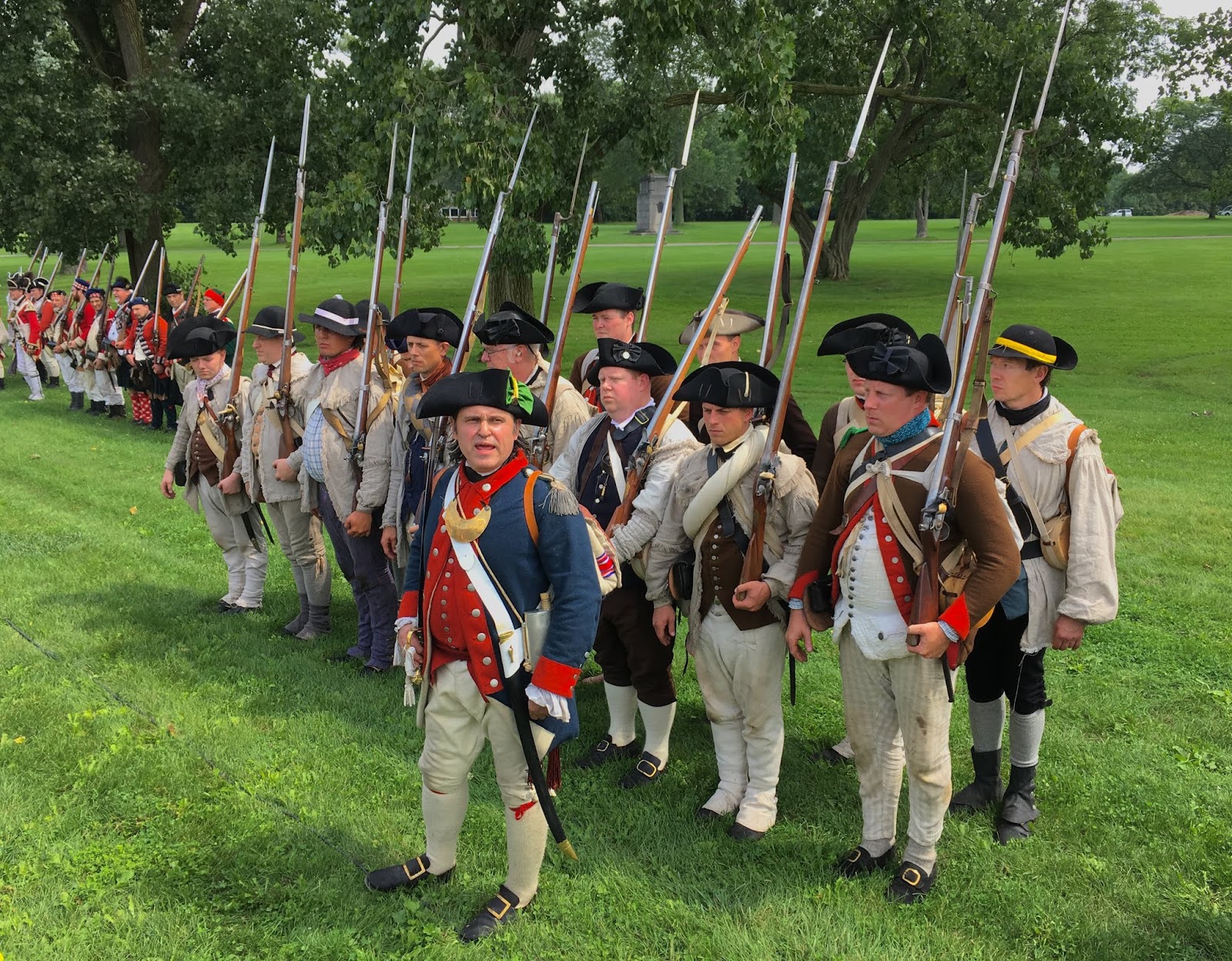
We went to Fort Meigs simply because we enjoy historical sites. Little did we know how good our timing was. We always thought the American Revolution happened from 1775-83. What we were not aware of is that one of the battles took place on August 25th, 2018 at Fort Meigs. We suspected something was going on when we saw several people in the parking lot in clothing about 240 years older than ours. Then we saw over 100 British and American troops and civilians hanging out in the fort together, before they met outside to fight just one more battle of the revolutionary war.

Re-enactment of the Revolution

The real history buffs amongst you will notice how weird that is. Fort Meigs was built in 1813 for the war of 1812 and then they fight a battle from ca. 1778 there. What I liked most about this battle was that after half an hour, all the dead stood up, lined up next to each other, answered some questions and then went back to the fort where they continued to show us how to make candles, how to draw maps without the use of an iPhone and how to cook without a microwave. They also had a 1800’s fashion show and re-enacted a court-martial. 

That's how Lewis and Clark made maps!
This is where we met this soldier, who was surprisingly nice, considering he had just deserted his post and had stolen two bayonets. He let me try on his uniform, which makes me want to go back to the 18th century even less. As if fighting a war isn’t bad enough, those wool uniforms are hot and heavy!

Hot and Heavy in 1778

The next day we went to “Sauter Village”, another living history museum (nope, we are not getting tired of them). After we had seen our first few Amish people on horse buggys the day before, we got to ride in one ourselves. Besides the horse, the price was very cute, too: Only two dollars! We also learnt about the life at a trading post, about schools for the kids of the pioneers, visited a weaving shop and a cooperidge. That’s where I got a job offered for just long enough to snap a picture.

Working at the cooperidge for a few seconds

Joy got very excited when we pulled up to the RV Hall of Fame. Yes, that’s a real thing. It honors historic and modern RVs  as well as people who shaped the industry. Even though we would induct Joy right away, she had to stay outside, but got a nice free, quiet spot to stay for the night next to a water fountain. We got to tour the museum, which featured RVs  almost as old as automobiles themselves. They actually had a 100 year old Ford Model T that was converted into a motorhome as well as Winnebago's very first motorhome. It was Joy’s version of finding long lost cousins. In the library we also read about novel ideas from the 60’s, like multistory RV Parks and RVing in Hawaii. It sounded like the future then, but obviously, neither really took off. 

RV Hall of Fame

The reason that the RV Hall of Fame is in Elkhart is that an astounding 80% of all RVs in America are manufactured in or around this small town in Indiana. Winnebago is one of the few exceptions. But since we did not get to tour their factory when we were in Iowa, we went on a factory tour of Thor instead, that’s the company that made MaRVy, our RV from our first big trip 10 years ago. They don’t allow visitors to take pictures on the floor, but it was fascinating to see step by step how the bare chassis becomes an RV. In some aspects, seeing the construction made me feel more confident, in which case of course I assume that Joy is built the same way. Other aspects made me a little more skeptical, in which case I assume that Winnebago somehow does it differently. I have not checked on that, so I will enjoy this false sense of security until we get to tour the Winnebago factory whenever we make it back to Iowa. Some sort of technical issues are part of living in an RV. Imagine you build your house, with plumbing and electrical systems and then shake and rattle it for an hour or two every day, of course every now and then something will not work. But we are glad to report that all the issues we had with Joy so far were very minor and easy to fix. I doubt she’ll last a century like the one in the RV Hall of Fame, but if we get a decade of joy out of Joy, we’d be happy campers indeed.

Our last stop before Chicago was at the Indiana Dunes. Such beautiful colors in the water and so much sand, it makes Big Beach on Maui look tiny in comparison. And it was hot enough that even Sandra went swimming! I had been to the Indiana Dunes about 28 years ago on my very first trip to America, with a group from the women’s shelter on the South Side of Chicago where my girl friend was volunteering back then. But I did not remember the dunes very well. I think back then I was more intrigued by the group of ladies and the fact that some of them had never been to Indiana….or even downtown Chicago!

Indiana Dunes

Speaking of a long time ago in Chicago: During our three days in the city, we got to see two friends who we had not seen in a quarter century! Gina came to the rescue when our RV parking spot at McCormick Place fell through. We got to hang out with her and her husband in Welmette, eat the best udon I ever had, tour the Bahai Temple in Evanston and the beautiful campus of the Northwestern University on Lake Michigan and enjoy a drink at a rooftop restaurant

Northwestern University in Evanston

Joy got to stay with Gina when we picked up Sandra’s sister at the airport and stayed in downtown for two more days. Before we picked up Petra, Sandra and I went to the one restaurant where we knew Petra did not want to go. The “Berghoff” had been THE German restaurant in Chicago, even 25 years ago, but back then I did not even know that I like German food, and coming from Germany, we had no interest (and not enough money) to go to The Berghoff. Now, coming from Hawaii and with a few more dollars to our name, we thoroughly enjoyed a delicious German lunch there. Who knew you can make Knödel out of Spätzle?

The Berghoff Restaurant

We got to meet Anna, another blast from the past, at the bean in Millennium Park. We wanted to go to the Jazz festival together, but first sat down to get dinner at an outdoor cafe to take advantage of this beautiful summer evening…or so we thought. We had just ordered our drinks when it started to rain. Actually, that is an understatement. In 48 years on this planet, I have never seen rain starting so suddenly and so heavily. In a split second, the scene changed from peaceful summer evening to a wet chaos. Luckily, there was an indoor restaurant close by, where we found refuge and a delicious meal. It was so nice to see Anna and Gina again. You know you have good friends if after not seeing each other for 25 years, it seems like nothing has changed, except that you have a lot to talk about. 

With Gina at the Lake

At first glance, it looked to me like the skyline of Chicago had not changed much since Sandra lived here. But I was proven wrong when we went on an architecture boat tour on the river and saw how much especially the riverfront has improved and how many more skyscrapers have been built. We had been on one of these cruises before, but this was the best one, not only because Gina got us on for free.

Divy Bike Trip along the Lake

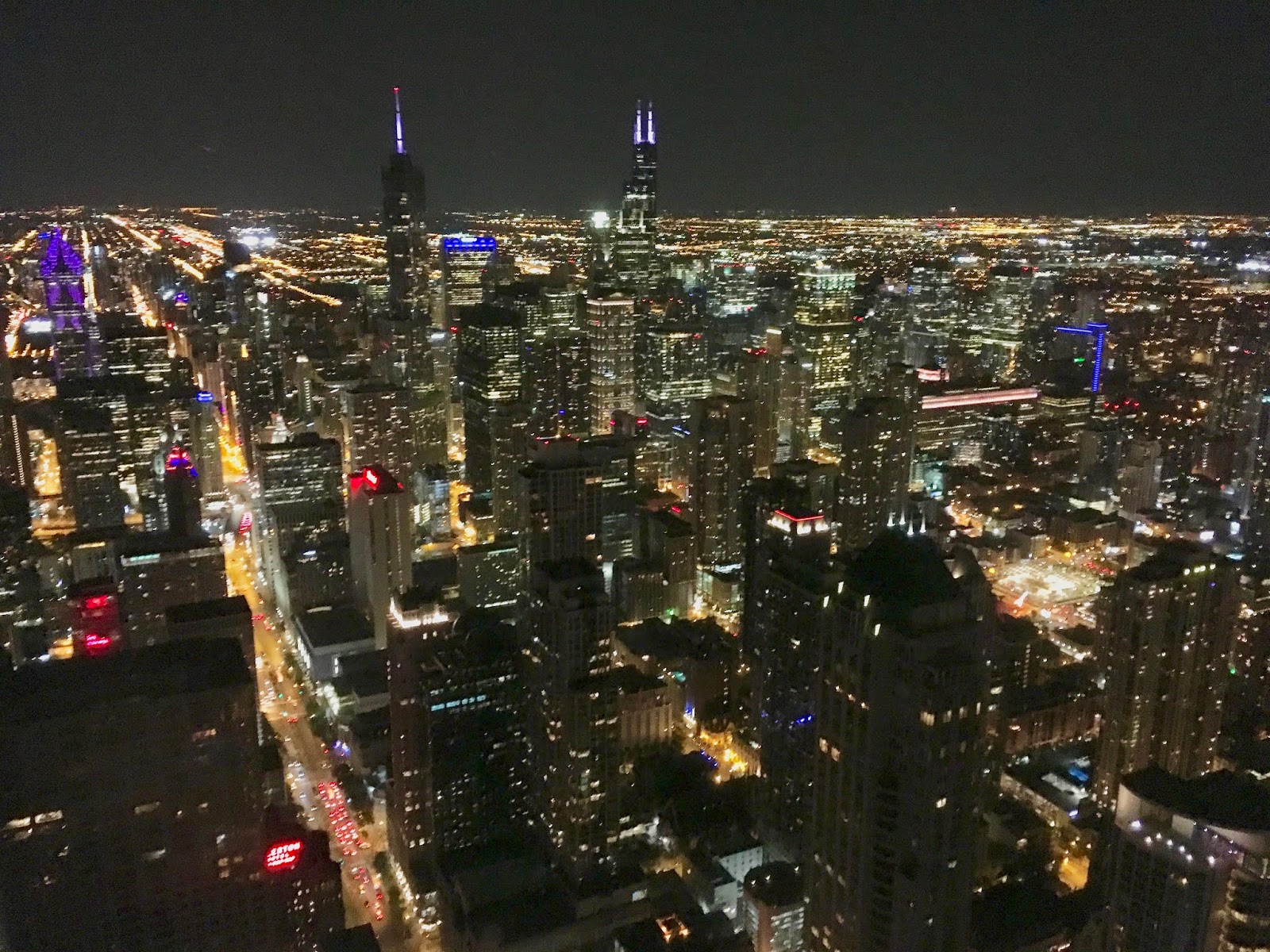
While in Chicago, we also used the "Divy” share bikes for a bike tour along Lake Michigan, went to the free Lincoln Zoo in Sandra’s old neck of the woods and had drink at our favorite bar, the Signature Lounge on the 95th floor at the Hancock building, still the best view in the city!

View from our favorite Bar in Chicago

We left Chicago and Gina the next day, but she was still with us in spirit, because we were so grateful for her suggestion to visit the headquarters of the SC Johnson company in Racine, Wisconsin. It’s an eccentric, historic and free tour that includes two Frank Lloyd Wright buildings, how did we not know about this before? For starters, we were not aware of the SC Johnson company, even though we should be. Amongst other things they make Zip-Loc, Shout, Off!, Autan, Draino, Raid and Windex, so we use their products pretty much every day. But until last week, I could not tell SC Johnson from Johnson & Johnson.

The tour started with a great movie about the company CEO following his fathers historic 1935 flight to Brazil in a custom-built amphibious airplane called “Carnauba” at a time and to an area where there were no airports yet. His father went there to look for a steady supply of a special palm wax, which was the magic ingredient on which the company built it’s fortune. But along the way, the trip also changed his life. The film was touching and a great introduction to the SC Johnson company, which was founded in 1886, but even though it’s now a huge global enterprise, it’s still headquartered in Racine and it's is still in the hands of the Johnson family. 

The reason they offer tours of their headquarters is that they are built by no other then our old friend Frank Lloyd Wright. Apparently, Mr. Johnson asked Frank Lloyd Wright 'not to build anything too ordinary’, which seems a bit redundant, kind of like if Sandra were to ask me to write about our week on the road, but to make it ‘not too short’. Obviously, Frank Lloyd Wright delivered the whole package: A spectacular and definitely not ordinary ‘research tower’ and a very unique ‘administrative building’, complete with quirks like leaking roofs, windows you can’t see through and chairs that fell over all the time. But gorgeous! So if you can’t get reservations at Fallingwater, I recommend heading to Wisconsin instead and take the free tour at the SC Johnson world headquarters. 

Headquarters from the SC Johnson compay

Our main highlight in Milwaukee was the tour at they Historic Pabst Mansion. Americans must have drunk a lot of Pabst Blue Ribbon beer back then to afford the Pabst family such a luxurious mansion. I might have guessed that they were German, I did not know how German they were: Apparently, mostly German was spoken at the house and a lot of the artwork and inscriptions throughout the mansion are in German. Funny how quickly the times have changed: A few decades ago, the house was supposed to be torn down to make room for a parking lot, now there is a bunch of historians working on re-constructing every little detail of the house and the lives of the Pabst family. Our tour guide gave a treasure trove of information about the house, the family and the brewery. 

Historic Pabst Mansion in Milwaukee

That night, we took advantage of our Movie Pass one more time, never sure when they will go out of business. “Julia, Naked” was playing at a local, artsy movie house. We loved the quirky movie and we loved the special effect after the movie was over: The story was set mostly in England and when we left the movie theater, they had spread so much fog around the whole city that we felt like we still were in England. 

The ‘Lizard Mound Park’ sounded more interesting on paper than it was in real life. There are dozens of man-made hills in a variety of shapes, including some animal shapes. They are burial and ceremonial mounds made by native Americans about 1000 years ago, but they were pretty small and even standing right next to it, we had a hard time making out the shapes. Of course it did not help that we found the entrance with all the explanations only on the way out. At least we learnt that there used to be over 20,000 of them, of which only 4,000 remain and these are the only ones in animal shapes. Risking that I lose my false reputation as a history buff: I found the critters on the plants more interesting than the mounds.

Distraction at the Lizard Mounds

Next stop: Green Bay. Obviously, I knew nothing about this town except the Green Bay Packers, who I don’t really now much about. But since they were not playing, we found two other attractions: First we went to the Nation Railroad Museum, where we got to ride on a train upfront with the engineer, see the huge 'Big Boy’ steam engine locomotive, Eisenhower’s mobil command train (think “Train Force One”) and the slick, but failed “Aerotrain”. 

At the National Railroad Museum

But the real highlight of Green Bay was the program the local Historical Society put on at the Cemetery that evening. It was called “If Tombstones could talk” and it featured 7 actors bringing to life local residents, telling their life stories right by their grave site. What a great idea! I am, not surprised the event is very popular with the locals, there were three large groups going from grave to grave, listing to what the tombstones had to say.

One of the seven "Talking Tombstones"

Sticking with the theme, we went to a ghost town the next day. “Fayette” on the Upper Peninsula of Michigan was a thriving company town built around an iron smelting operation. It was only in operation for 24 years in the late 1800’s, but they left behind many of the town's buildings and they are located on such a scenic spot, that it was turned into a state park and it is most pleasant and interesting to visit. But as pretty as it is, it did not make us want to live there, not now and definitely not in the 1800’s. That’s actually a common thread throughout pretty much all historical sites we go to. As much as we enjoy visiting historical sites, I am perfectly happy being born much later and would not want to go back to live in any other time period. 

Fayette Ghost Town

Last night we had one of our prettiest campsites of our trip, right by a lake, on a little bluff, very nice full-timer RVing neighbors, a beautiful sunset, even a little beach… But just before we forget how lucky we are to live on Maui, the wind started blowing so cold that we had to abandon the pretty scene in a rush. If this is what early September feels like, we don’t want to know how winter feels around here. Another ‘Lucky we Live on Maui” moment happened at our picnic lunch today. We found the most beautiful rest stop on Lake Michigan, it was warm and sunny and had a great view…but also wasps and biting flies, which made it a little harder to enjoy the beautiful spot. So lucky we live on Maui, where the winds are warm, the flies don’t bite and the temperature is always above average...

Don't let the pretty picture fool you it was COLD

Today we got to see Kitch-iti-kipi Lake, or the 'Big Spring' at Palms Book State Park, in case that rolls easier off your tongue. Since it’s such a mouthful of a name, it makes up with easy-to-remember stats: This  spring fed lake is 45 feet deep and has a constant temperature of 45 degree Fahrenheit all year long. And most of the trout you see in the lake are Lake Trout, now that I might remember! I’m not so sure about the name. The spring at the bottom pumps out 10,000 gallons of water per minute, but surprisingly, the lake looks very calm. And it has the clearest water I have ever seen anywhere. Clearer than Molokini, where it’s always 100-200 feet visibility and clearer than some of the drinking water we’ve filled our bottles with. 45 feet below the surface, we could clearly see a pacifier in the otherwise unspoiled lake. Not sure whether mom was afraid of the 45 feet or the 45 degrees, but I don’t blame her for not going after it.

View into Kitch-iti-kipi

They’ve put a self propelled raft on a wire straight across the lake to allow for the full effect of the clear water and to see the springs and the fish through the large opening in the middle of the floor of the raft. It was so fascinating (and so free) that we took the tour twice.

It’s hard to believe that we will not be sleeping in our beloved ‘Joy’ tomorrow…but WE ARE GOING BACK TO THE ISLAND TOMORROW!!! Mackinac Island that it. You didn’t think we’d be done with this trip, did you? It’s just half time!

Aloha from the UP in Michigan,
Chris, Sandra & Petra

Tuesday, August 28, 2018

How we met our long lost American cousin - 8th update from Chrisandra's Roadtrip

Aloha all,
this is a special edition for a very serendipitous event last week. It's one more reason for me to be happy that I married Sandra, since I would not be Chris Weininger otherwise...

If I ever had to get a “real” job again and if I could pick where that would be, I might pick a presidential library. Of course they might prefer somebody with a real history background, not some German who only knows a little bit about the presidents he has visited. But in fantasy world, Director of a Presidential Library might be a fun job for me. For a couple of seconds, I thought that fantasy had come true:

Imagine my surprise: In Fremont, Ohio, we arrived at “Spiegel Grove”, the home of Rutherford B. Hayes and the first real Presidential Library in the country. We walk into the museum and literally the very first video welcome message starts off:  "Welcome to the Rutherford B. Hayes Presidential Library. My name is Christie Weininger and I am the Executive Director…” Wait, who?? what???

First, we went to the bathroom to wash out our ears to make sure that we heard this right. Well, not really, but we did listen to the video a few more times and made sure she spelled her name ‘the right way’. Hearing your own name might be kind of fun if your last name is somewhat common, but it’s unheard of for us. Weininger is not a common name in Germany or in America. Neither one of us had ever met a Weininger who wasn’t one of Sandra’s relatives!

So of course we had to ask whether our long lost cousin was around. It took a few hours to connect, but if you know us and presidential libraries, you know that we tend to hang around for many hours anyway. And there was plenty to do: We took the regular tour through the home of President Hayes, visited the museum, and took a 'backstairs tour' from the servant’s perspective. In the evening they had a big band concert on the veranda. The concert might not have been in our honor, but that’s when we finally got to meet the mysterious Christie Weininger. And we felt right away like we found a new cousin, she’s just as nice as all the other Weiningers we know. 


We quickly found out that her greatgreatgreatgreatgreatgrandfather was Adam Weininger from Stuttgart. Sandra’s dad was from Stuttgart…as if we needed any more proof that we are related. Obviously, we were very excited. I can also see that Christie was very excited, she had never met a Weininger from the old world. But what surprised us was how excited everybody else at the museum was, too. Wherever we went people asked us whether we were Christie’s German cousins from Hawaii. I guess Christie must be a really nice boss that they were all so happy with her. We even had a photo shoot with the PR person of the Library to record this historic event.

Of course we accepted gladly when Christie offered to take us to her hometown to meet more Weininger the next day. We had no plans anyway plus we still had not seen everything in the museum. And even with all the excitement about Weiningers, we still wanted to learn about President Hayes, too. Interesting fellow, by the way: He was elected in 1876, the centennial of the declaration of independence. At the Republican convention, he finished a distant 5th on the first ballot. The leading candidate James Blaine had almost 5 times as many votes as Hayes. But all the other delegates had one thing in common: They hated Blaine and after seven round of voting, they agreed on Hayes as their nominee. If you think that was close, wait for the general election! You might remember the 2000 election Bush vs. Gore that was so close that it took several weeks to determine who would be president. For Hayes, it took four months! Two days before the inauguration (which was in march back then), it was finally decided that Hayes would become president. I will not bore you with all the details of his presidency (of course not because I forgot most of what I read last week). But one thing that made us relate to him was that apparently he loved to travel as much as we do. He took a 71 day trip throughout the country, making him the first sitting president to travel west of the Rocky Mountains. 

The next day we increased the number of Weiningers we have met in the US about tenfold. Christie took us to her home town, about 45 minutes south of Fremont and even with just a few hours notice, she got a whole bunch Weiningers together, who apparently all wanted to meet their long lost cousins Sandra and Chris. We went to cementeries, homes, farms and dentist offices all proudly displaying the Weininger name. We are particularly thankful to the the one ancestor who corrected the spelling back to the correct way, apparently Adam had dropped an ‘e’. I don’t think I would have asked at the museum if the greeting would have been from Christie Wininger. 

After an afternoon of touring the various Weininger sites we got some delicious fresh Weininger peaches, had some beer and pizza with three generations of our new extended family before taking off again. Hopefully we will get to see them again, whether it’s in Ohio, Hawaii or Germany. And if we ever have a tooth ache during our road trip, I hope it’s going to be close to the Weininger Family Dentistry in Ohio. 

Aloha,
Chris, Sandra & Christie


I hope we have some of Auntie Mae's longevity genes...


They actually have a family tree all the way back to Adam, but not Eve..

Before they corrected the spelling... 

I'd rather not get a tooth ache, but if I do, I hope it's close to here


Friday, August 24, 2018

Plenty of Prehistoric and Presidential Points of Interest since Pennsylvania - 7th Update from Chrisandra‘s Best of Both Worlds Roadtrip


Aloha all,

I feel a little guilty about all the fun things we‘ve done this week, while our sweet hometown Lahaina is dealing with a huge brush fire and a hurricane at the same time. Several friends had to evacuate and Sandra and I have both been busy all day assisting guests who could not make it in our out of West Maui. But there is nothing else I can do right now, so I might as well keep up with our adventures on our blog. 

After all, we‘ve been to the sweetest place on earth, learnt about several new–to–us presidents, stumbled over a new–to–us National Park, saw the site of the oldest proof of human habitation in America and met a cousin we did not know we had!

If you read the last update, you know how much we enjoyed the various estates from the Du Ponts in Delaware. One prettier than the other, but all slightly tainted by the fact that they were mostly built on the fortunes from making gun powder, thus profiting from other people killing each other. Our next stop was not tainted that way. Au contraire: Hershey is not only a most pleasant town, it is also completely built on profits from making chocolate…how sweet is that!

The town that chocolate built

Maybe somebody who actually lives in Hershey will burst my bubble some day. There might be a dark side to this town (other than dark chocolate), but our impression of this place was very much in line with their motto: ‘The sweetest place on earth’. It reminded us of Telluride or the movie ‘Pleasantville’: Just a little too good to be true. 

We first stopped at Chocolate World, which is like a Mini Chocolate Disney World, except that it’s free, including the Disney style ride that explains the process of making chocolate. Then we took a historical trolley tour through town, with a fun and informative guide passing out free chocolate throughout the tour. On that tour we learnt that the whole town is built on the chocolate fortune from the very generous Mr. Hershey, including the children’s hospital and the free school for orphans which has grown to accommodate over 2000 underprivileged kids at no cost to them. Ann should be proud, she and other chocoholics really support a good cause here in Hershey. 

After the chocolate capital of the world we went to the state capital of Pennsylvania. As you know, that’s one of our things to do, so of course we took a tour of the state capitol in Harrisburg. And you might also guess that, of course, we loved it. Running the risk of sounding like a broken record: This might have been the most impressive state capitol building we have ever seen! But you are not going to guess how much we liked our tour guide, or will you?

Yet another prettiest state capitol of them all!

Well, our tour guide was mediocre at best. Not terrible, but we found it ironic that the most impressive state capitol had the least enthusiastic guide. We did not realize how uninspired she was until we left the building. There were all these TV crews around the capitol. She had mentioned that we could not see the Supreme Court room because it was being used. She failed to mention why. As we found out from one of the reporters outside and from a CNN news alert on my phone, they had just announced the findings of the grand jury that investigated the Catholic sexual abuse scandal in the very building we were in. And our tour guide either did not know or was unable to include it in the  tour, which sounded like she had given word by word a few hundred times already. 

As if sexual abuse by priests is not depressing enough, we also visited the National Civil War Museum in Harrisburg und the battlefields in Gettysburg. We had been to Gettysburg before, but we had missed two very interesting sites. We did not even know about the Cyclorama, which was under renovation when we were here last. Not really sure what to expect, we bought tickets, watched a movie and then went to the Cyclorama. I was already pretty impressed by this modern looking multimedia presentation. It brings to life and explains the battles on a 360 degree painting with impressive light and sound effects. And I was totally blown away when I learnt at the end that the main attraction, the painting itself, was created 135 years ago in 1883!

Obviously, the first president anybody would associate with Gettysburg is Lincoln. What I had not heard before is that the Gettysburg Address he gave here, wasn’t an instant hit with everybody. History might rank it as one of the best speeches ever given, some contemporary reviews were less flattering, speaking of “silly, dishwatery remarks” that shall not be repeated or thought of ever again. 

But we actually went back to Gettysburg because of another president. As we found out, Dwight Eisenhower had his home pretty much right in the middle of the historic battlefield. We took a tour of his farm and home, where he retired after he was done defeating the Nazis and being president. By the way: Planning D-Day was not his only talent. Turns out, he’s also a pretty good painter. We like Ike and we liked Ike’s paintings, too:

We also went back to Ike’s farm for a sunset ranger program. It was about September 1958, when Eisenhower invited Khrushchev to America during the Cold War. It’s a fun story and includes the Soviet leader publicly throwing a temper tantrum because he did not get to visit Disneyland. We loved hearing the story told by a national park ranger around sunset at the Eisenhower farm, but it should be pretty entertaining even if you just read up on it online.

Ranger talk at the Home of President Eisenhower

We want to thank all of you who ever ate any ketchup. Because part of that profit went indirectly to the Heinz History Center in Pittsburgh. And what a deal that was. For one low price we got admission to three interesting sites. The museum itself had a diverse collection of Pittsburgh history from Westinghouse and other innovators to the story of the Heinz Company, steel and glass manufacturing all the way to the set of Mr. Rogers Neighborhood. Included with the History Center is also the Fort Pitt Museum. The museum gave us a little better understanding of the French and Indian Wars, which I was not aware, were a global affair and are by some historians described as the first world wide war. The location at the tip of the golden triangle in downtown Pittsburgh reminded me a lot of the “Deutsches Eck” in Koblenz. I wonder whether any of you been to both places and feel the same way?

Golden Triangel in Pittsburgh

The third part of the History Center is actually outside of town at the Meadowcroft Rockshelter. There is a small living history village and an Indian village where you can try your luck at hunting an Elk with a spear. 

No elk were hurt in the making of this photo...

They also had a historical baseball game played by 1890 rules going on. But the main attraction is the rockshelter archeological site. When this site was excavated in the 70’s, it literally rewrote the history of human habitation in North America. Up until then it was believed that the first humans came here about 10,000 years ago. This site has evidence of human habitation from 16,000 years ago, which still makes it the oldest known site in North America today. Not bad for just an extra freebie to museum admission.

Meadowcroft Rockshelter, the oldest evidence of human existence in North America!

Ohio has a bunch of presidents, but don’t worry, I realize not everybody finds presidential history as fascinating as we do, so I will not bore you with all the details. But I have to briefly mention them. We saw the memorial and gravesite for James Buchanan, who gets most of the blame of not avoiding the civil war, but neither did any other president and he seemed to have been a decent person, just caught in an impossible position. Then we visited the home of James Garfield and the memorial and museum for William McKinley presidents 20 and 25. Both of them fought in the civil war and survived, but for both of them the presidency proved to be far more dangerous. Both of them were assassinated while in office. 

If you know nothing about President Garfield besides that he loved lasagna, don’t feel bad. Neither did we. But he did have a lasting effect on future presidential elections. Until then, candidates did not campaign for themselves. Apparently Garfield was such a good orator, that he decided to break with that tradition. Since rallies around the country would have been frowned upon, he started the short lived tradition of ‘front porch campaigns’. Trainloads of people from all across the country came to his home to hear him speak. Can you imagine if we still had the old tradition? Can you imagine the Clinton/Trump election without ever hearing from either of them? Not sure Garfield considered all the consequences...

President Garfield's home, or the birthplace of presidential campaigning 


The fact that surprised me the most to learn at the home of President Garfield had nothing to do with him, but with his wife. Even though she seems to have been a very emancipated woman, running the estate by herself for many years after her husbands untimely death, she was against women’s suffrage. That is really hard to comprehend for me. If it had not been a subject at all, I could see that she didn’t fight for it. But since there already was a growing suffrage movement at the time, I can’t understand how a lady of her statue could not be supportive of it. I wonder whether we do anything today that will look as weird to future generations. 

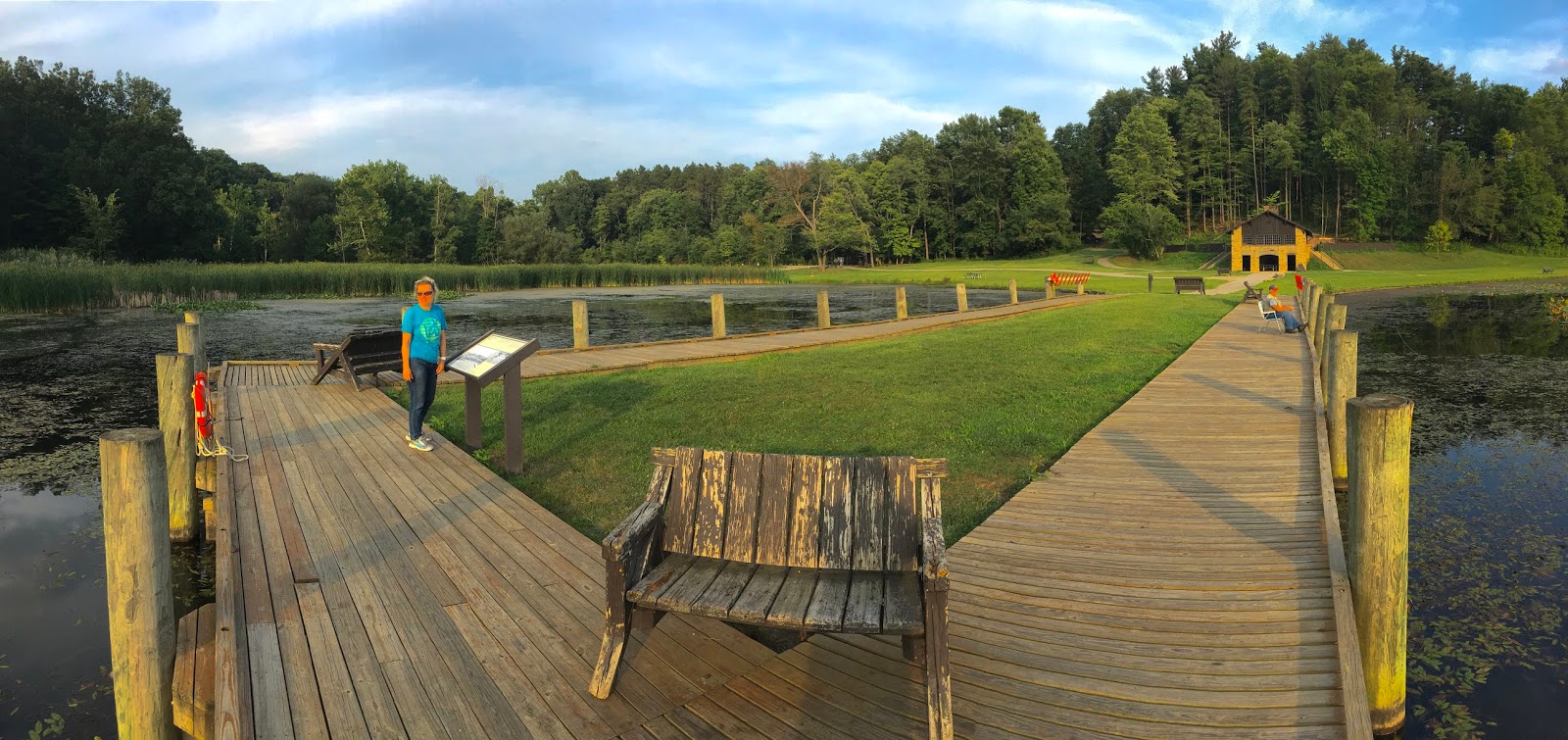
Usually we plan visits to national parks way in advance. Not so this week. We literally had not heard of Cuyahoga Valley National Park outside of Cleveland until we saw the exit signs on the highway. This is no Grand Canyon, but it still had enough history and natural beauty to keep us busy for a day and a half. We got a private ranger walk around Kendall Lake. It might not look like much, but it’s pretty impressive that this is all man made. The lake, the pier, even the trees are products of the CCC. So thanks to FDR giving young men something to do during the depression 80 years ago, we got to go on this walk and many bats, birds and beavers got a new home. 

Artificial pier on a manmade lake surrounded by trees planted just 80 years ago.

The visitor center of the park will get a new home soon, too. We had heard of this being done, even of extra floors being inserted, but never saw it ourselves: This historic house got lifted off the ground and gets a new foundation before they 'drop' it back down:

The floating house at Cuyahoga Valley National Park

We also learnt about the importance of the canals in the early days of Ohio. Still considered wilderness when the country was founded, it became the 3rd most populous state by the 1850’s, mostly because of the network of man made canals. It tells you something about how inaccessible the land still was if these narrow canals were considered such an improvement. Boats had to be pulled by mules, no faster than 4mph! And to go from Lake Erie to the Ohio river, there were way over a hundred locks that each took half an hour to several hours to pass through. No wonder the canals quickly disappeared after the railroads came. 

In the domed observation car on the scenic railroad

We also took the scenic train ride through the park, riding in a domed observation car with a very nice Canadian couple and went on another ranger walk along “The Ledges” with fun Ohioan family. 

Our ranger guide trying to explain how much a million years is...
Even million year old "Ledges" were improved by the CCC boys

Since it happens so often that we spend a whole day in just one museum, we planed only on the Thomas Edison birthplace in Milan, Ohio for the next day. This time it was the other way round. The tour through the very modest house was interesting, but not very long. Even with listening to several of his phonographs and reading all the historical markers, we were done in about an hour. So we had time for just one more quick museum to visit in the afternoon...or so we thought....

Genius grown here! Thomas Edison Birthplace
The ‘quick visit’ turned into a two day event and included one of the most serendipitous experiences we have ever had on any of our road trips. So serendipitous and interesting in fact, that it will fill a whole update by itself...so I hope you’ll come back to our blog soon to read all about it!


Aloha from Ohio,

Chris, Sandra and Christie